How Menorcan Sobrasada Is Made: Traditional Elaboration Step by Step
Menorcan sobrasada isn’t manufactured — it’s crafted. The difference isn’t semantic. An industrial sausage is produced on a line, with machine-controlled timing and uniform results. Artisan Menorcan sobrasada is made by hand, with time and judgement. The result is a completely different product.
Here’s the full process — from the pig to the cured sausage that reaches our shops, made by Trebaluger and Raima, the two artisan charcutiers we work with.
The Menorcan pig
It all starts at the farm. Quality artisan sobrasada is made with free-range pigs — animals that graze outdoors, eat natural feed and grow without rush. Menorca’s climate, wetter and windier than other islands, directly influences meat quality.
The most common breed on Menorca is the crossbred white pig, though some farms also work with black Mallorcan pig. What matters most isn’t so much the breed as the rearing conditions — a pig that has lived well gives meat with more intramuscular fat, more flavour and better texture for the sausage.
The traditional slaughter — the matança — used to take place in autumn and winter, when cooler temperatures favoured preservation. Today production is more continuous, but the best artisans still respect the seasonal rhythm.
The ingredients
Menorcan sobrasada has exactly four ingredients:
- Lean pork — loin, shoulder and other prime cuts
- Pork fat — which gives it the spreadable, unctuous texture
- Sweet or hot Vera paprika — or a blend of both, depending on the variety
- Salt
Nothing else. No preservatives, no colourants, no artificial flavourings. The deep red colour comes exclusively from the paprika. The spreadable texture comes from the right ratio of lean meat to fat — roughly 70% lean to 30% fat, though every artisan has their own formula.
Some varieties also include garlic, pepper or local spices, but the purest and most Menorcan recipe is the four-ingredient one.
Grinding and mixing
Once the cuts of meat are selected, the process begins with grinding. Artisan production uses a coarse-disc grinder — the goal isn’t a fine texture but one where you can see distinct pieces of meat and fat. The result is more rustic and interesting than industrial sobrasada, which uses finer discs for a more uniform texture.
Next comes the mixing — combining the ground meat with paprika and salt for as long as it takes for the ingredients to fully integrate and the mixture to develop that deep red colour and unmistakable aroma. It’s physical, manual work that takes experience to know exactly when the mix is ready.
The resulting paste rests refrigerated for 24-48 hours so the flavours settle and the paprika fully permeates the meat.
Stuffing
Natural pork casing is cleaned, soaked and hand-filled with the sobrasada paste. The casing’s diameter determines the later curing time — the thicker it is, the longer it needs to cure properly.
The most common formats are:
- Longaniza — thin casing, quick curing (3-4 weeks), softer texture
- Medium sobrasada — the most common format, 2-3 months of curing
- Rullada — a large piece rolled onto itself, slow curing over several months
- Camot — sobrasada with Menorcan sweet potato, a specialty unique to the island
Once stuffed, each piece is tied with natural twine and hung to begin curing.
Curing in the tramontana wind
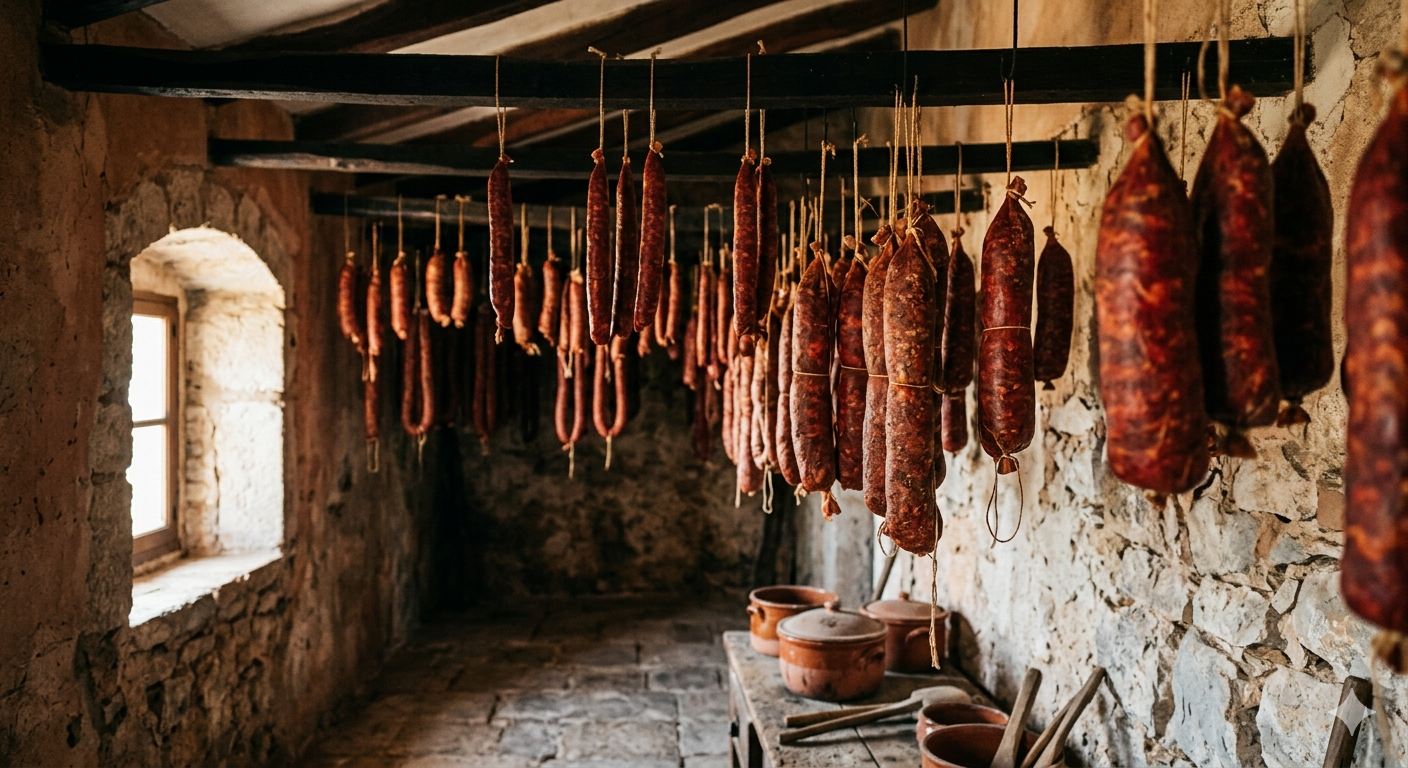
Here lies the secret of Menorcan sobrasada. The pieces hang in naturally ventilated curing rooms — windows angled to catch the tramontana, the north wind that sweeps Menorca for months on end. This cold, dry wind is what makes natural curing possible without temperature-controlled chambers.
During the first weeks, the sobrasada loses moisture and the casing dries and clings to the paste inside. The paprika keeps working — its natural antioxidant properties act as a preservative, and the colour deepens progressively.
The artisans turn and check the pieces regularly, making sure curing progresses evenly and no defects appear. It’s work that requires constant attention and can’t be delegated to any machine.
The final result — after weeks or months depending on the format — is a sobrasada with a slightly firm crust, a red and unctuous interior, and an aroma that fills any room where it’s cut.
The difference with industrial sobrasada
Industrial sobrasada is made in 7-10 days in temperature- and humidity-controlled chambers. Artisan sobrasada needs weeks or months. The difference in the result is so large the two almost feel like different products.
The artisan version has:
- A more rustic, uneven texture — you can see pieces of meat and fat
- A more intense, deeper colour — the paprika has had time to fully integrate
- A more complex, lingering flavour — with notes beyond the paprika
- Less moisture — which makes it more concentrated and easier to keep
Trebaluger and Raima — the charcutiers we work with
At s’Aturadeta we work exclusively with Trebaluger and Raima, two of Menorca’s most respected artisan charcutiers. Both follow traditional processes — local pigs, natural ingredients and curing in the island’s own air.
The sobrasada you’ll find in our shops in Mahón and Sant Climent is the same one Menorcans have eaten for generations. We vacuum-pack it for free so you can take it home without any trouble.
Want to pair it with Mahón PDO cheese, honey or gin in a gourmet basket? Build yours here.